Monday, September 14, 2020

Finding Your Book’s Target Audience & Benefits and Filling a Need

Three things that will not only help with marketing but also in writing your book: audience, benefits, and filling a need. Ask yourself:

• Who is my target audience?
• What are my book’s benefits?
• Does my book fill a need?

Let’s consider audience first. Create a reader profile sheet. This can guide you when writing the book, but the greatest benefit comes when you’re ready to begin marketing. Write down the following aspects as they relate to your target audience:

• Age
• Gender
• Income bracket
• Location
• What are their hobbies and interests?
• Where do they shop?
• Where do they frequent?
• What magazines, websites, and news sites do they read?
• What are their needs?
• Where do they hang out online?

Fill in as much information as possible. Refer back often to your reader profile and continue to add details. The more you know about your readers, the better you can tailor your book to appeal to them. (Still write the story you want to write but be aware of what your audience likes.) Really get to know them. It will also be that much easier to reach them when you’re ready to promote.

Now, what are your book’s benefits? How will it enrich your readers’ lives?
Are they reading for entertainment? Will your book amuse them? Will you help them to escape their everyday lives? Will they enjoy the experience?

Are they reading for enrichment? Will your book deliver meaningful and deep views? Will readers be moved by the experience?

Are they reading for information? Will your book expand their knowledge and understanding?

Are they reading to better their lives? Will your book help them save time or money? Will it provide healthier options? Can your book solve their problems?

This is where you really need to place yourself in your reader’s shoes. There are millions of books on the market. Why should they read yours? “They’ll enjoy it” is not enough. You must give people compelling reasons to read your book, appealing to their logic, their emotions, or both. Brainstorm every possible benefit.

Finally, does your book fill a need? There are several aspects to consider.

Does your book provide information people are actively seeking? Is it new information or a unique take on a subject? Are changes in the world (technological, political, etc.) making this information necessary or beneficial?
v Is your book tied to events, locations, or people? Is there a demand for this information? If other books already exist, will you provide new or more current details?

If a work of fiction, is it part of a new or growing trend? (Current trends will be on the slide by the time your book hits the market.) Is your story unique and fresh? Is there a demand for the storyline or specific genre?

That’s a lot of questions! However, the more you can answer, and in as much detail as possible, the better equipped your book will be to succeed.

Monday, September 7, 2020

4 Book Marketing Mistakes to Avoid in 2020

For many people, the downtime that’s come with quarantine has provided an interlude with which to focus on publishing aspirations. If 2020 is the year you’ve decided to focus on your career as an author, then you’re likely also looking for ways to spruce up your marketing efforts. To provide you with a helping hand, here are four marketing mistakes to avoid — and what to get right instead.

1. Avoiding book cover conventions of your genre

You’re strolling through the cookbook aisle of a bookshop. As you scan the covers featuring close-ups of delectable dishes, beautifully set tables, and laughing celebrity chefs, you stop when you come across a dark cover featuring gold embossed lettering and some sort of shadowy creature. You think to yourself, “that must have wound up on the wrong shelf,” and continue on your way. The moral of this little scenario? A book cover that stands out might catch a readers’ eye, but if it grabs their attention because it looks out of place, they’ll quickly move on. While this might sound obvious, it can be a tricky line to balance. Your cover should immediately give readers a sense of what genre it falls into by incorporating at least a degree of that genre’s visual conventions. You can simultaneously ensure your cover stands out by including key story elements, and, of course, making sure it looks polished and professional. Consider these regency romance covers: A quick glance immediately reveals a few conventions: a woman with her back to readers, flowers, Victorian dresses, and Garamond-ish typeface. Chances are you didn’t need me to tell you you were looking at historical romance covers to immediately know the genre. Now let’s take a look at some of the contemporary romance novels currently topping Amazon’s Best Sellers list: Here we see illustrated covers and bold typeface that fill the majority of the space. Contrasted against the regency covers, these feel decidedly modern. Whether you’re hiring a professional cover designer or going the DIY route and designing your own, look through other books in your genre to get a sense of what readers will expect to see. Then when you decide which story elements to feature, work it into the framework of those expectations.
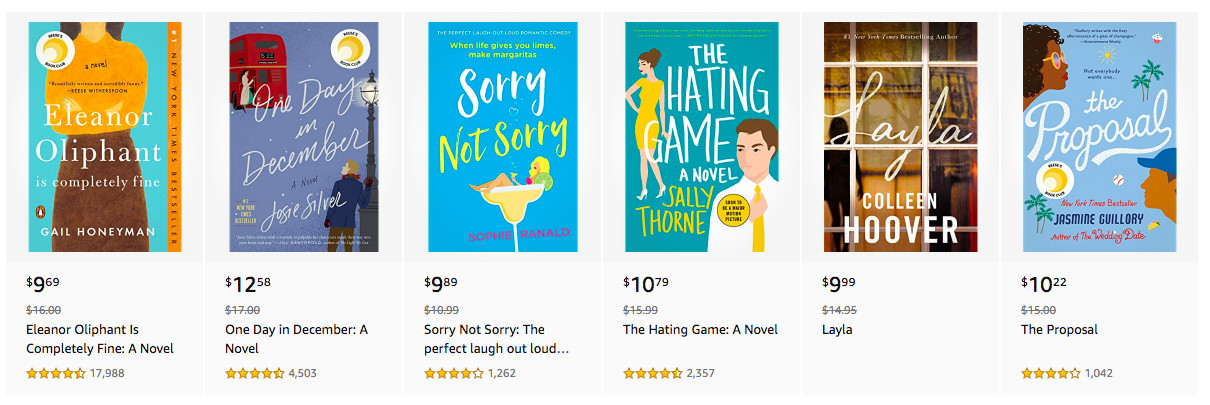
2. Giving too little — or too much — info in the book description

Book descriptions have a reputation amongst authors — and not a good one. After writing and revising every single detail of your book, it can be hard to accurately judge what information is totally necessary to include in the book description. How can you really sell your story to readers without at least mentioning the various subplots that bolster the main narrative arc?! A good way to walk the tightrope of providing enough information without veering into dreaded infodump territory is to use this basic structure:

Start with “The Hook”

There are a few different approaches you can take in regards to the hook. If you have an effusively positive review, you can start with that as a way of delivering prospective readers social proof that others have enjoyed your book right off the bat. Alternatively, you can give readers your book’s elevator pitch, incorporating key details such as genre, major themes, series name (if your book is a series installment), or any awards you may have won. Here’s a great example of an opening hook that includes theme, accolades, and genre from The Raid by Steven Konkoly: A Border Patrol murder exposes a high-level conspiracy in USA Today bestselling author Steven Konkoly’s explosive thriller.

Follow up with “The Blurb”

Here’s where you want to continue painting the picture for readers by providing them with key story details. Need help defining ‘key details’? Well, a good rule of thumb is to stick to these three elements:
  • The protagonist. Give readers a birds-eye view of who they are.
  • The conflict. What is the major challenge facing your protagonist?
  • The stakes. What does your character stand to lose?

End with “The Wrap Up”

Here’s where you want to give readers an idea of who should read your book. Are you writing a historical romance with shades of sci-fi? Let readers know that fans of Outlander will enjoy your novel. Writing a dystopian novel with teenage protagonists? Mention that your book might make a great gift for teens who enjoyed Maze Runner or The Hunger Games. The wrap up is another great place to include positive reviews, if you’ve got them!

3. Not setting up a mailing list

It’s not easy to build a readership as an indie author. It takes a lot of effort and determination. There may be no shortcut when it comes to marketing to (and connecting with) readers when you publish your first book. However, you can make life a lot easier the next time you publish a book by setting up a mailing list. That way, when publication #2 comes out, you’ll already have a list of people to tell about it. And if they already read and enjoyed your first book, they’re going to be much more likely to buy your second book. (And, of course, if everyone on your mailing list rushes to buy your book, you’ll help it climb of the Amazon Best Sellers list, allowing new readers to discover your latest title, too!) For a step-by-step guide on how to set up your own list — as well as tips for getting people to sign up to it! — check out our free, ten-day course on mailing lists.

4. Not seeking pre-release book reviews

Amazon gives special treatment to new publications. But if you don’t take the time to lay the groundwork for a strong book launch, you may squander those precious first days after hitting the ‘Publish’ button. One way to ensure you hit the ground running is to seek out pre-release book reviews. This way, the extra visibility your book receives upon launching will not only ensure readers are finding your book, but the social proof provided by your reviews will encourage them to also buy your book — providing it with even more visibility, so on and so forth. Here are a few ways to find pre-release reviews:  
  • Reach out to existing followers. If this isn’t your first book release, you may already have an existing base of readers. Or perhaps you have a mailing list set up, or an active social media account. Reach out to those followers and offer them advanced reader copies (ACRs) in exchange for early user reviews.
  • Book review blogs. There are tons of bloggers out there who are willing to provide editorial reviews in exchange for an ARC, and you can find a whole directory of them here.
  • Reedsy Discovery. Ahem, allow us to plug for a moment our own book review platform where authors can submit newly published books and get matched up with a reviewer in their genre for $50. Learn more here.

Wednesday, September 2, 2020

Insecure Writer's Support Group Contest, #IWSGPit, and More!

It’s time for another group posting of the Insecure Writer’s Support Group! Time to release our fears to the world – or offer encouragement to those who are feeling neurotic. If you’d like to join us, click on the tab above and sign up. We post the first Wednesday of every month. I encourage everyone to visit at least a dozen new blogs and leave a comment. Your words might be the encouragement someone needs.


The awesome co-hosts today are PJ Colando, J Lenni Dorner, Deniz Bevan, Kim Lajevardi, Natalie Aguirre, and Louise - Fundy Blue!


September 2 question - If you could choose one author, living or dead, to be your beta partner, who would it be and why?


The IWSG Anthology Contest deadline is today, September 2!

Guidelines and rules:
Word count: 4500-6000
Genre: Science Fiction
Theme: Dark Matter
Submissions accepted: May 6 - September 2, 2020
How to enter: Send your polished, formatted (double-spaced, no footers or headers), previously unpublished story to admin @ insecurewriterssupportgroup.com before the deadline passes. Please include your full contact details, your social links, and if you are part of the Blogging, Facebook, Instagram, or Twitter IWSG group. (Must be a member to participate.)
Judging: The IWSG admins will create a shortlist of the best stories. The shortlist will then be sent to our official judges.
Our judges: Dan Koboldt, Lynda R. Young, Colleen Oefelein, Damien Larkin, Ion Newcombe, Julie Gwinn, and David Powers King


Did you know the IWSG is more than a website?

Find us here:
Facebook, Twitter - hashtag #IWSG, Instagram, and on Goodreads

And you can sign up for our monthly newsletter loaded with tips and more here - IWSG Newsletter

The newsletter also lists new books by members, so contact us if you have a new book out.


Writers and authors, join us for #IWSGPit on January 20, 2021. 


It will be here sooner than you think! 


Polish those pitches and check the #IWSGPit rules.

 
Multiple authors have signed with publishers and agents as a result – it could be you!


What author would be your beta reader? Have you entered the contest? Going to participate in #IWSGPit?