Tuesday, December 7, 2021

The Best of...Carolyn Howard-Johnson


Carolyn Howard-Johnson is a frequent help to the IWSG with her blog posts and newsletter tidbits that offer writers advice that is entertaining, helpful, and easy to digest.

My copy of The Frugal Book Promoter

One of the many great things about Carolyn's books is she takes into consideration all avenues of publishing. Whether self-published or traditionally published, there is advice specific to each situation. Whenever I read one of her books, whether it is the Frugal Editor or the Frugal Book Promoter, it's with a highlighter, pen, and notepad ready. There is something to take note of on every page. 

To thank Carolyn for all of her help with the IWSG, this "Best Of" post is our thanks. 

Here are some of our favorite Carolyn lists and snippets of advice. 

Suggestions for preparing yourself to be the best publicity partner around. (From Carolyn's January 2014 IWSG post.)

1. Join organizations like IBPA (Independent Book Publishers Association) where you’ll learn to understand the world of publishing from every angle—your, that of your publicist and that of your publisher. And get the support you need along the way.

2. Subscribe to newsletters sent out my experts in the field of publishing. Dan Poynter, John Kremer, Penny C. Sansevieri, and one of my favorite publicity gurus Joan Stewart are all online resources for getting online information that isn’t rooted in myth and gossip. You’ll learn tons from my Sharing with Writers newsletter, too. Subscribe by sending a SUBSCRIBE message to CarolynHowardJ@AOL.com.

3. Take a class in public relations. The only way I know how to avoid drastic mistakes in choosing a class is to patronize your local college or attend writers’ conferences sponsored by universities.

4. One of the most frugal ways to learn a new skillset is to read. Most of those who publish free newsletters like the ones I mentioned above have books that will get you off on the right foot. Find mine here.

A list of the best way to help your writer friends. (From Carolyn's August 2019 IWSG post) 

1. Be a critique partner. We all need help polishing our manuscripts. As a critique partner, we also learn a lot about our own writing in the process.

2. Mark the book as ‘Want to Read’ on Goodreads. That helps it get noticed more. Plus vote for it if it appears on a Goodreads list.

3. Offer to host the author on your blog during his virtual tour. Either ask for a guest post or send interview questions. Even just a feature on release day helps spread the word.

4. Sign up to be on the author’s street team. You’ll promote on multiple platforms and get all sorts of cool bonus goodies.

5. Promote it on Facebook. Post notifications of the book’s upcoming release or host a Facebook party.

6. Promote the book on Twitter. Send out Tweets about the book – with an image. Retweet the author’s book tweets.

7. Promote the book on Instagram. If you have a review copy, take pictures of it. Same with Pinterest.

8. On release day, announce the book to your followers, friends, family, and fans, whether online or in the real world. Let them know they need to buy this book. Tell your local library and bookstore to order it. Hound them if you have to!

9. Buy the author’s book! Even if you got a free review copy. Years ago, Carolyn Howard Johnson said that was the number one thing you could do to support an author.

10. Review the book. Goodreads-Amazon-iTunes-Barnes and Noble – wherever! Just leave a review or at the very least a star rating. The book will get more notice with more reviews. Just make sure it’s an honest but not overly negative review. (If you’re out to slam other authors, you are in the wrong line of work.)

Tips on Monetizing to generate additional income (From Carolyn's August 2019 ISWG post) 

1. Offer ads or sponsorship in the backmatter of your book. Be sure your offer includes the ways the ad will benefit the advertiser or sponsor including how you will feature your benefactor in social networking you’ll be doing during the launch. 
2. Accept only professionally produced ads. 
3. Accept only ads that would interest your target audience. Be prepared to refuse some with the “not quite right” phrase that literary journals use to reject submissions. 
4. Limit the number of ads to just a few. 
5. Encourage ads that give discounts or freebies to benefit your readers. In fact, you could offer a discount on the price of the ad to those who do.
6. Don’t undersell your ad, especially if you already have an extensive platform. 

Best advice from Carolyn throughout the years from her April 2017 post: 

"Authors! We are ultimately responsible for our own careers."

So, start studying up and get to work! 


The Frugal Book Promoter, Third Edition! 
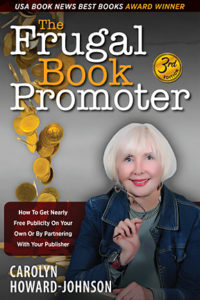
This multi award-winner, now in its third edition,  celebrates its 16th Anniversary as the flagship of Carolyn Howard-Johnson’s HowToDoItFrugally Series of books for writers. For only a few cents a day the third edition of The Frugal Book Promoter assures your book the best possible start in life. The author was inspired to write this book full of nitty-gritty how-tos for getting nearly-free publicity for her UCLA Writers’ Program class. A former publicist, journalist, and retailer, Carolyn shares her professional experience as well as practical tips gleaned from the successes of her own book campaigns. She tells authors how to do what their publishers can’t or won’t and why authors can often do their own promotion better than a PR professional.

Since its first release almost two decades ago, this book has won multiple awards:


Winner USA Book News Award 

Runner-up in the how-to category for the Los Angeles Book Festival 2012 awards

Global Ebooks Award Honorable Mention

Silver Medal from Military Writers Society of America

Wednesday, December 1, 2021

December 2021 IWSG


Our Twitter handle is @TheIWSG and hashtag is #IWSG.


December's Optional question is: In your writing, what stresses you the most? What delights you?

Many thanks to our awesome co-hosts for the December 1 posting. PJ Colando, Diane Burton, Louise – Fundy Blue, Natalie Aguirre, and Jacqui Murray, you guys rock!


Greetings Fellow Insecure Writers,

2021 is winding down. (Pause for disbelief and a head shake.) We've made it through another year of global turmoil. (Pause for a pat on the back.) I hope that all of us in the IWSG have made it to the end of this year better than simply surviving. I hope we've all made it to the end with our faith in humanity still in tact and that we all found at least a few reasons to smile in 2021. 
How about you? Can you think of some glimmer of sunshine that shined on you in 2021? If you can, share it in the comments. If you haven't. I'm sorry. (Pause for virtual hugs.) Fell free to also share your  griefs in the comments too, because we care. That's the hallmark of the IWSG. It's not just a group for the nuts and bolts of writing, we also care about the concerns that cause our insecurities too.

Now for the IWSG news and info:

Juneta Key is now the Instagram Admin. If you have an Instagram account, be sure to follow. Juneta will be sharing group info, updates, and I'm sure will be sprinkling some fun writerly stuff in here and there.

And be on the look out! January is coming. That means we will have new anthology winners to be announced and the Twitter Pitch is coming!

The next #IWSGPit will be in January 26, 2022, 8:00 am - 8:00 pm Eastern Standard Time


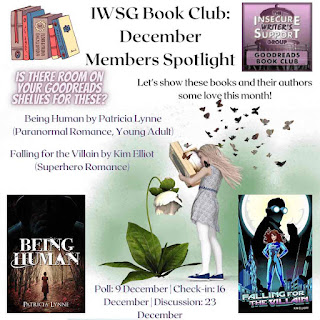
Support your fellow insecure writers. Our December IWSG Goodreads Book Club Member Reads are below. Answer this month's poll on December 9th; check-in December 16; and discussion day December 23rd.


This month's book picks:
Being Human by Patricia Lynn 
and 
Falling for the Villain by Kim Elliot 

Monday, November 22, 2021

Another Medium for Story Tellers: Video Games


As writers, we can all think back to certain stories or events that inspired us, trailheads of creative journeys we may not have even known we were on. I had one such experience at age 11, when I was drawn into the tale of a knight who sought redemption for his dark past and fought to save the world from destruction. With his companions, he traveled on flying ships and fought countless monsters, journeying to the underworld and eventually to the moon. My fingers held tight to the controller as the story unfolded in pixelated glory, synthesized music swelling with each revelation, betrayal, and heroic sacrifice.

Final Fantasy IV wasn't my first video game, but it was the first time I'd found myself caught up in the narrative of a game world. Of course, computer games had been telling stories for a couple decades before that, and they've only gotten better in the thirty years since.

Video games are a fascinating combination of technology and creativity, and they inspired me to learn computer programming in grade school. I went on to study engineering in college and worked almost 20 years as a software systems engineer. Though I dabbled with a few hobby projects, I never felt compelled enough to seriously return to my old dream of making games until I rediscovered my love for writing. After all, it wasn't just the gameplay or fancy graphics that had drawn me into those worlds!

Recently, my friend Anna 'Lavinnia' Kończak asked me to co-write a game called Poseidon's Orb. The story was already outlined and partially written when I joined the team, which included artists, musicians, programmers, and voice actors. The player takes the role of Charlotte, a singer who's been turned into a merperson and forced to steal a powerful artifact from the undersea kingdom of Aquatris.

Poseidon's Orb is a visual novel, a genre of game that incorporates a story told primarily through text with graphical depictions of the characters and setting. Background music and voice acting further enhance the experience, but the heart of the game is its narrative. Often, visual novels give the player the opportunity to make choices that affect the story. Some of these change the course of the plot, much like a Choose Your Own Adventure book, while others only affect the player character's attributes or relationships.

I was originally tasked to write a few scenes that develop the relationship between Charlotte and one of the story's love interests, King Benjamin. As the project went on, I ended up writing much more, including the entire third act and several of the story's endings. As my first sizeable game writing endeavor (the script is about 31,000 words), I learned a lot while working with a friendly, supportive, and talented team.

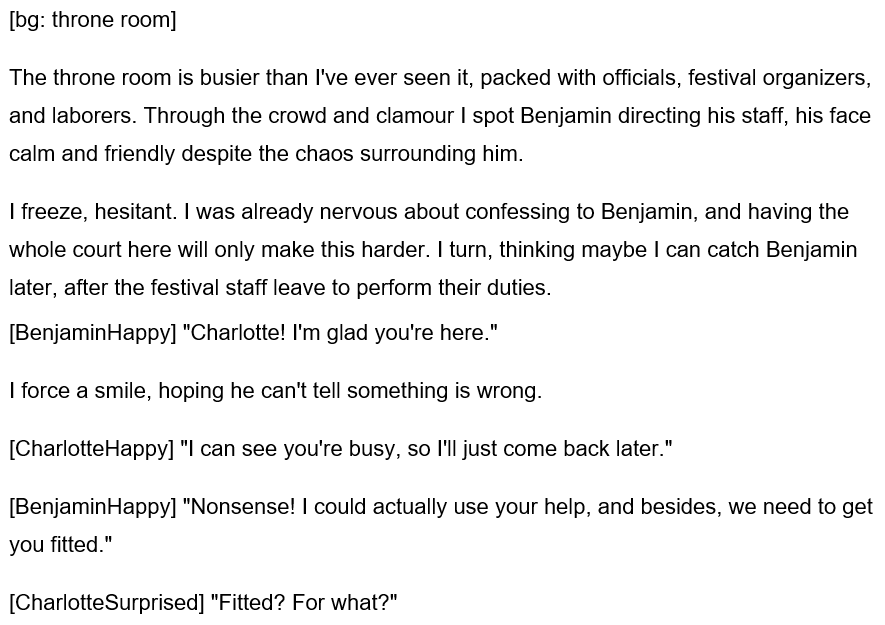
The writing style was a mix of first person prose and screenplay. We didn't follow standard screenplay format, but all dialogue was marked with tags indicating the character and an approximate emotion. This helped the voice actors deliver their lines with the correct feeling and the artists to create facial expressions for the characters. The programmer also referenced the markup to ensure that the game showed the correct character art for each line of dialogue. The setting for each scene was also explicitly stated (though without the standard slugline) so that the background artist could create the environments.


An excerpt from the Poseidon's Orb script. Note the background callout as well as character dialogue tags. This doesn't follow conventional screenplay format, but is easier to convert to the visual novel programming language we used.


Writing a visual novel first and foremost requires the same basics as writing a traditional novel: good storytelling, efficient prose, and impactful dialogue. However, the interactive medium presents its own unique challenges. Because the reader (or player) will be able to make choices, it can be tempting to explore every possible direction the story can take. However, this becomes unwieldy in a hurry. It can also lead to an inflated sense of the story's length, since the more branches the narrative takes, the greater the percent of story that is unread on any given playthrough.

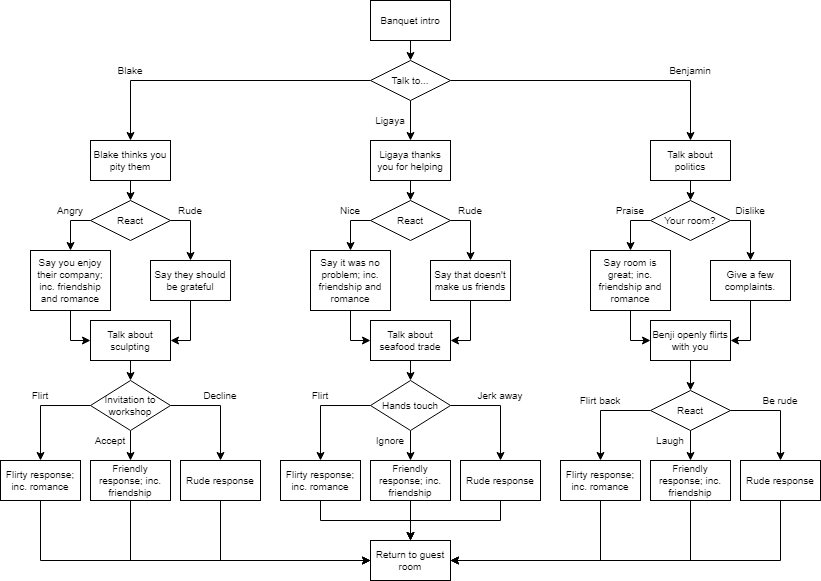
Writers of interactive fiction have techniques for keeping a story manageable while giving the player a feeling of freedom. One way to do this is with scenes that consolidate a number of different branches. For example, early in Poseidon's Orb the player can choose which of the three potential love interests to spend time with at a banquet. Regardless of which conversation the player experiences, the story continues in the same way.


Story flow diagram for the banquet scene early in Poseidon's Orb. The player can talk to one of three love interests and choose how to react during the conversation. All three paths follow a similar structure for simplicity, and all end back on the main story thread.


Another way to create consequences from player choices is with statistics based on their actions. While this may not necessarily create a new path in the story, it might change the way an event takes place or how a particular character reacts to the player. In Poseidon's Orb, we tracked friendship and romance points for each of the three love interests, increasing the player's standing with each character based on certain dialogue selections. The primary intent was to change how conversations with each character flow, but there are a few story implications as well (if you're mean to everyone, don't expect a happy ending!).


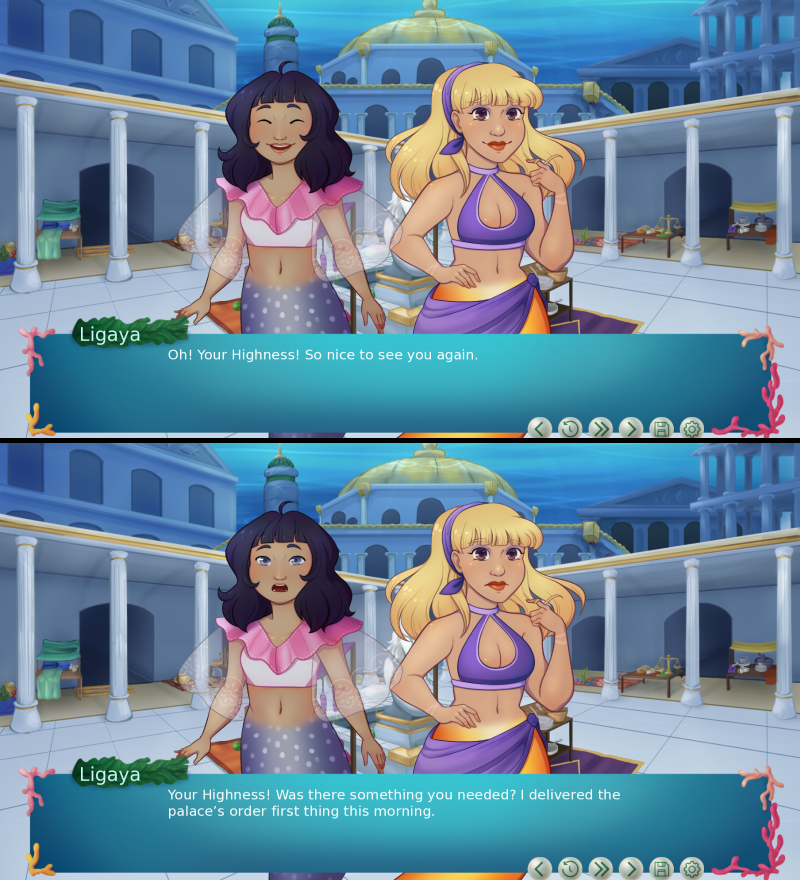
Ligaya (left) greets you differently in this scene based on whether you've been nice to her. Note that both the text and the characters' facial expressions have changed. If you've been unkind to Ligaya (bottom screenshot), you are given the choice to make amends... or not!


Visual novels aren't the only place for writing in games, of course. Most games today include some form of storytelling, whether through textual or voice narration, character conversations, item descriptions, lore documents, or movie-like cutscenes. Creative game designers and writers are always finding new ways to use the medium and evoke memorable emotional responses.

If you're interested in learning more about visual novels, I highly recommend browsing free games on itch.io (you can filter by price and genre, among other things). Aaron A. Reed's series 50 Years of Text Games offers a fascinating history of interactive fiction, starting with the original version of Oregon Trail (a text-only simulation played via teletype). If you'd like to try crafting some interactive fiction yourself, Twine and Ink are great beginner platforms, as neither requires programming skill to get started. Ren'Py is the visual novel engine we used for Poseidon's Orb. For a deeper discussion of the craft, check out blogs by Susan O'Connor and Emily Short.


Bio

Joshua S. Robinson grew up a computer and video game nerd, became a software systems engineer, and didn't discover his love for writing until age 30. He has since authored and self-published a novel, written lots of unpublished short fiction, and made a handful of small video games. He lives in West Virginia with his wife.


Links

Article text

URL

Final Fantasy IV

https://en.wikipedia.org/wiki/Final_Fantasy_IV

Anna 'Lavinnia' Kończak

https://lavinnia.itch.io/

Poseidon's Orb

https://rodfireproductions.itch.io/poseidons-orb

itch.io

https://itch.io/

50 Years of Text Games

https://if50.substack.com/

Twine

https://twinery.org/

Ink

https://www.inklestudios.com/ink/

Ren'Py

https://www.renpy.org/

Susan O'Connor

https://www.susanoconnorwriter.com/blog

Emily Short

https://emshort.blog/

Joshua S. Robinson

https://wordyrobin.com


Image by R. Javier from Pixabay