Showing posts with label story structure. Show all posts

Monday, May 22, 2023

Do You Have a Great Story on Your Hands?


Many people know they want to write but find themselves stalled at the first hurdle. They can’t put pen to paper (or finger to keyboard) because they don’t know if they have a story idea that’s worth writing. And novel writing is a big investment – not just in terms of time, but emotionally too. It makes sense that we’d want to be certain we have a winner on our hands.

That’s why with The Novelry’s creative writing courses, we begin with a breakdown of what makes a cracking story. And from your very first one-to-one coaching session, a bestselling author in your genre will help you assess and mould your idea to make sure it’s got legs.

Remember: a good story almost writes itself. Get off to a good start and you’ll fly through the writing process.

To help you decide which of your ideas to commit to the page, we’ll give you a little primer in this story assessment – but come and find us to sign up to a course once you’re ready to really dive in!

Don’t let your insecurities become obstacles!

While self-doubts may creep in, you shouldn’t let them be the reason you don’t write. For many writers – including The Novelry founder, Booker Prize-listed author Louise Dean – the story evolves during the writing process. So even if your plot isn’t razor-sharp and airtight just yet, you might find it takes shape once you stop criticising it and instead open yourself up to its possibilities.

Compare your story to the greats

We’re not talking about trying to write like Tolstoy – writers should honor their own unique voices.  What you can do is lean on  some of the all-time classic story structures in fiction, to develop a stand-out story that’s both comfortingly familiar for readers but has your own unique twist based on your life experience and the things that matter to you.

At The Novelry, we suggest writers immerse themselves in the deep but simple storytelling archetypes using fairy tales and folklore to help them learn the art of storytelling. In fact, global bestselling author Harriet Tyce enjoyed the course and wrote about how she’s found inspiration for her stories in fairy tales.

So many writers can write but if only it were all about the writing! Readers buy stories, not fine or fancy words, and so do publishers, so ensure your story affects readers, and work with some of the biggest stories of all time, while mining your own hidden desires with our Classic Course to compe up with the story only you can tell, a story readers will love.


Consider your theme

Rather than striving to work out every beat of your plot, take a step back and assess the bigger picture of your story.

A great way to do this is to pinpoint the theme(s) you’re aiming to explore. Consider this as something you feel strongly about, then look at the journey your main character or hero goes on towards enlightenment. The first half of your book will be the old world where things are wrong, and in the second half of your book your theme will emerge to provide your hero with a better way to live there life. Once you have your theme, you can consider every element of the story in terms of how it best serves it.  You can start to sketch your setting – a time and place that brings your theme into sharp relief. And then come your main characters and minor players too. Try a protagonist who’s spectacularly ill-equipped to tackle the trials of your theme for high drama, or someone being tugged by its opposing ends. If your theme is the desire for solitude versus the need for community, it might be a recluse who’s forced into close proximity with others – perhaps a family member falls ill, they get a new job, they need a flatmate. Now you’re telling a story!

Make sure there’s a problem

That brings us on to the next point: your story needs conflict. If nothing is wrong in your protagonist’s life, there can be no character arc, no development – in short, no story.

As writers, we can fall in love with our fictional characters and want to make their lives as easy and joyful as possible. Resist that temptation; be mean, and then meaner. Make their life difficult, watch them squirm and see them grow!

A great story starts with a devilish dilemma or a life-and-death problem.

See how high your stakes are

Simply having a problem isn’t enough. That problem needs consequences – preferably of the dire variety. What will happen if your character doesn’t address the conflict at the heart of your story? Why should your reader care if they fail or succeed?

Remember: this is fiction. It doesn’t need to be true to life. Lots of writers, particularly those starting out, simply need to raise the stakes and they suddenly have a fantastic story on their hands. Don’t be scared to bring the drama!


Look to the middle

The midpoint of your story will tell you a lot about what you’re working with. Essentially, the midpoint is the perfect place to build the structure of your plot around. It’s a point of no return for the protagonist and usually brings a new realisation – we see them at their lowest, and they start to understand what needs to change for them to reach the conclusion. The midpoint bridges the old story world and the new. Our founder, Louise Dean, says she picks up a plot by the midpoint as the simplest way to structure a story with events which compound the problem to the left and those where things begin to drop into place to the right.

If you can pinpoint your midpoint, with a path from a beginning and to how your story might finish (remember, you don’t need details yet!), that spells a very positive story prognosis.

Don’t leave your story to chance!

These tips should help you understand the magic of your story and make sure it’s one readers won’t be able to put down.

But remember, if you want support through every step of the novel-writing marathon,, we’re ready and waiting to give you a warm welcome at The Novelry, the world’s favorite creative writing school with courses, coaching and community to guide your journey through the woods.


The Novelry is a creative writing school that offers something unique: one-to-one coaching with bestselling authors and the chance to work with editors from major publishing houses. With live writing classes and events every week, we’ll be your novel writing team, focusing on what matters most – helping you write the very best story you can. With more five-star reviews than any other creative writing course program, our writers have called our approach ‘life-changing’.

Homepage: https://www.thenovelry.com/

Courses page: https://www.thenovelry.com/courses/which-course

Coaching page: https://www.thenovelry.com/coaching/writers

Editors page: https://www.thenovelry.com/coaching/editors

Creative writing blog: https://www.thenovelry.com/blog


Monday, July 11, 2022

The Hero’s Journey by Melissa Bourbon

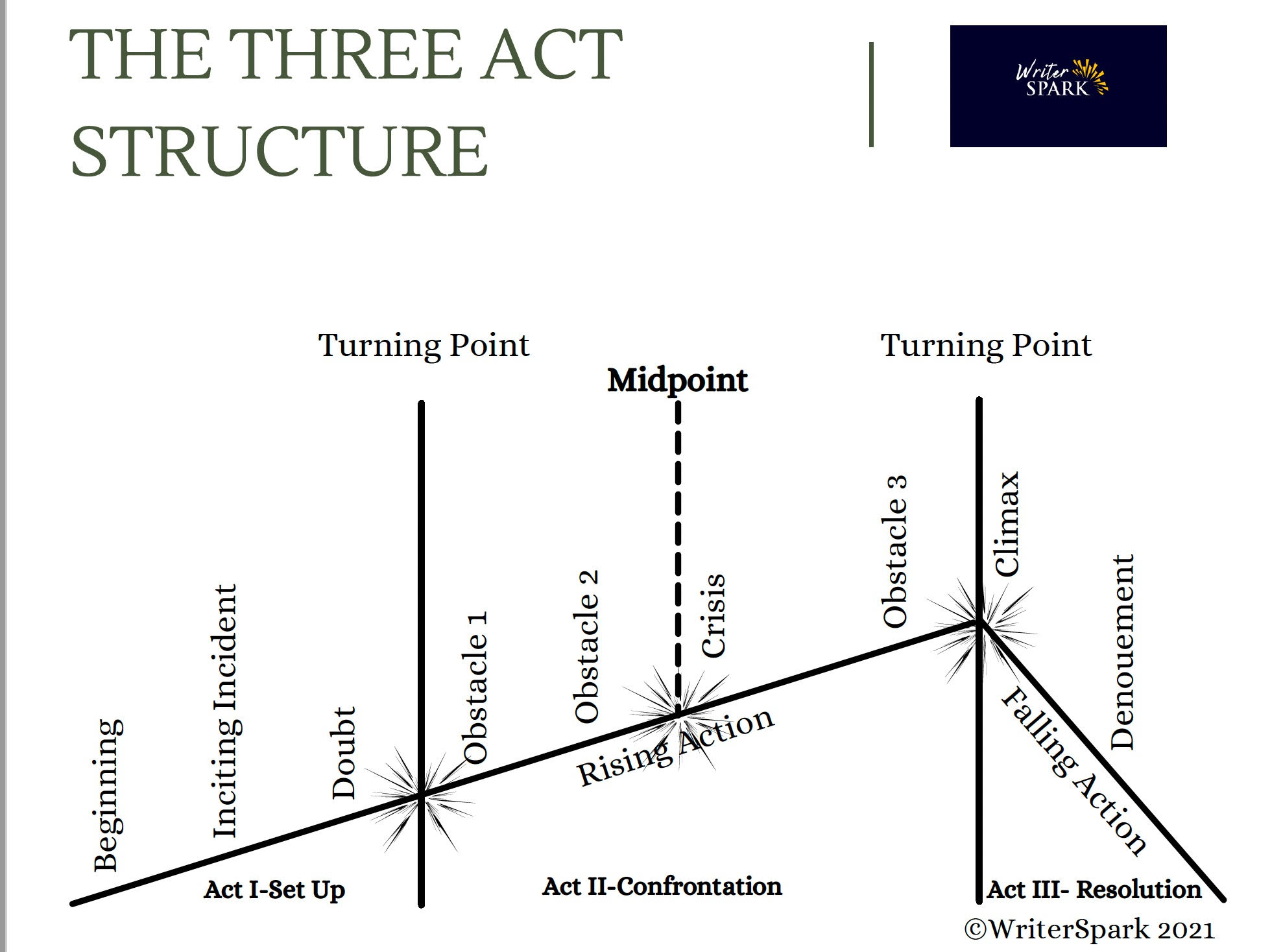
Listen in on a discussion about story structure between authors and I’d bet a lot of money that no two people will agree on exactly one method. Some adhere steadfastly to the Three-Act Structure. Others like the Three-Act Structure on hyperdrive, broken into eight sequences. Some use the 15 beats from Save the Cat. Still others swear by The Hero’s Journey.

First, let me say that any of these work. There is no right or wrong answer.

What I also want to say is this: these story structures are essentially—at their cores—the same. In each, there is a protagonist who starts the story in their normal life, who then enters a new world, must overcome obstacles in the form of turning points, hits a climax, and ultimately resolves the conflict that has been the external driving force throughout the book.

Today I want to share with you how two of these structures intersect so you can see it.


Let me start by saying what the Three-Act Structure is NOT. It’s not a formula. It doesn’t tell you, the writer, what to write or what should be happening. It’s not specific like that.

What it IS is a guide, or a narrative model, which breaks a story down into three parts: a beginning, a middle, and an end.
Act I is the setup of the story. (20-25%)
Act II is the developmental part of the story. (50-65%)
Act III is the climax and resolution to the story. (15-25% )

Act I shows the protagonist in his/her normal existence. Something happens to take him/her into a new world. This is Act II. A lot happens. There are turning points. Enemies are faced. A turning point leads to Act III where the climax happens, followed by the wrap up.

The majority of the book is spent getting to that climactic moment.

This is basically true in every story structure model. There is a lot of ‘two steps forward, one step back’ as the protagonist faces conflicts and works to overcome whatever obstacles are in the way of success.


The Hero’s Journey stems from Joseph Campbell’s Monomyth, which is basically a story template in which a hero goes on an adventure, faces obstacles, is victorious, and comes back home a changed person.

Christopher Vogler, a Hollywood screenwriter and exec, used Campbell’s The Hero with a Thousand Faces and created the Writer’s Journey, which details the mythic structure for storytellers and screenwriters, specifically.

Here’s the overview of the Hero’s Journey.

Hero lives in the ORDINARY WORLD


There is a CALL TO ADVENTURE
There’s a REFUSAL OF THE CALL
The hero MEETS THE MENTOR then
CROSSES THE THRESHOLD (, which takes the hero into the new world.
TESTS AND ALLIES happen along the road of trials.
The APPROACH TO INMOST CAVE tests the hero’s mettle.
The CENTRAL ORDEAL is a major turning point in which the hero experiences a major triumph. It as the midpoint.
There is a REWARD, but pysche! A new conflict arises on
the THE ROAD BACK. A turning point leads to
the RESURRECTION, which is the CLIMAX and the
RETURN WITH THE ELIXIR.

You may look at this and feel completely overwhelmed. Believe me, I get it. But let me show you how the Three-Act Structure and The Hero’s Journey look like side by side.


When you look at them next to each other, you can see how the core parts intersect.

During Act I (Three-Act Structure), we see the hero in his/her ordinary world (Hero’s Journey). This shows what the hero will leave behind. There is a call to adventure (Hero’s Journey) (which is the same as the inciting incident in the Three-Act Structure). Something happens, encouraging the hero to leave the ordinary world behind.

The hero refuses that call. This can happen by personal choice, someone else’s choice, or through situation.

A mentor is introduced, usually during Act I, to give guidance to the hero.

A Threshold Guardian may be an obstacle to crossing the threshold.

Act I (Three-Act Structure) ends when the hero does cross the threshold (Hero’s Journey) and enters the new world (beginning of Act II).

Act II (Three-Act Structure) comprises the rising action. In it, the hero faces trials and tribulations, meets allies and enemies (Hero’s Journey), and faces obstacles which test his/her strengths and weaknesses. A turning point (Three-Act Structure) brings the hero to the inmost cave (Hero’s Journey), which leads to the MIDPOINT (Three-Act Structure) and the CENTRAL ORDEAL (Hero’s Journey). Success is at hand.

The hero experiences success and the reward that comes with it. The ROAD BACK (Hero’s Journey), however, brings more obstacles and leads to the final turning point of ACT II (Three-Act Structure), which leads the hero to the final battle or obstacle.

The beginning of ACT III (Three-Act Structure) is the RESURRECTION (Hero’s Journey), which is the CLIMAX (Three-Act Structure). This is the moment everything in the book has been leading up to. The CENTRAL ORDEAL showed us that the hero is prepared for this battle. Failure against the antagonist, though, is still a possibility.

Finally, the DENOUEMENT (Three-Act Structure) includes the hero RETURNING to the ORDINARY WORLD with the ELIXIR (Hero’s Journey).

As you can see, both of these popular story structures is essentially the same. The vocabulary is different, but the forward momentum of the story follows the same trajectory regardless of what structure is applied.

My point in sharing all of this is to encourage you to internalize the story structure that makes sense to you.

If Blake Snyder’s 15 Beats from Save the Cat clicks for you, then use it.

If identifying the 8 sequences in your three acts works, then use that.

Maybe the broad strokes of the Three-Act Structure is enough for you, or maybe you like the more specific guidelines The Hero’s Journey takes a protagonist through.

Remember, there is no right or wrong way to write a story. My hope is that seeing how elements in story structures overlap with one another, like the Three-Act Structure and The Hero’s Journey, you can find a way that works well for you.

Happy writing!


Melissa Bourbon is a national bestselling author of more than 26 novels, and is a coach, mentor, and teacher. She divides her time between writing her various series and with the WriterSpark Academy, developing and teaching courses and content to help aspiring writers—and writers who want a refresher or need inspiration—take their craft to the next level.

Visit WriterSpark Academy’s website, on Facebook, and on Instagram @Writer_Spark
View WriterSpark Courses at:

Find out more about Melissa here, on Instagram @bookishly_cozy, and on Facebook
And feel free to email her at writersparkacademy@gmail.com

Monday, February 20, 2017

Story Trumps Structure with Steven James, Award-Winning Author


Today I’d like to welcome Steven James, the author of the award-winning book STORY TRUMPS STRUCTURE. He is also the author of the thriller EVERY CROOKED PATH. I asked him 5 questions about writing organically, how to build tension, and more. Welcome, Steven!

Get it on AMAZON


1. Why should writers worry more about story and less about structure?

Often, structure gets in the way of excellence. As soon as you sit down to write three or four acts, or whatever it might be, you’re using an easily-identified paradigm and could end up with a cookie-cutter story. Instead, focus on pursuit, desire, believability, escalation, and so on. All of the narrative forces that help shape a story, regardless of its length or structure. 

2. For writers who struggle to write organically, without an outline, what piece of advice can you give them?

Ask yourself four questions, and you will never be without the next moment of your story. First, what would this character naturally do? Then have him or her do it always. Allow them to act in character and to act believably. Second, how can I make things worse? This relates to the narrative force of escalation and allows the story to continue to build toward a climax. Third, how can I add a twist? Look for a way to end the scene in a manner that is unexpected an inevitable. Fourth, what promises have I made that I have not yet kept? Then look for a way to keep them. 

3. What is one writing rule that you hear all the time that you believe should be broken?

Plot out your story before you write it. This ends up forcing so many stories into a corner and into predictable patterns. Allow the story to emerge as you work on it, asking the questions that I just went through, and the story will have a vibrancy that you never realized before that it could have.  

4. Which elements should writers focus on to create engaging stories?

Write stories that have emotional resonance by looking for struggles that your character has that readers will be able to identify with. Keep everything believable and don’t confuse your readers. Confusion will end up trumping any other reader response. For example, if you want them to be in suspense but they’re confused, they won’t be in suspense. If you’re trying to build romantic tension and they’re confused by what’s going on, they won’t be engaged. 

5. What is one thing a writer can do to build tension in a story?

Allow readers to be aware of danger that the character within the story is not aware of. For instance, readers know that there’s a bomb in the car that will ignite when a key is placed in the ignition. Then, readers will worry as the character approaches the car, unlocks it, and positions himself in the driver’s seat. No matter what genre you write in, building tension and suspense will help with reader engagement. 


BIO:
Steven James is a national bestselling novelist whose award-winning, pulse-pounding thrillers continue to gain wide critical acclaim and a growing fan base.

Suspense Magazine, who named Steven’s book THE BISHOP their Book of the Year, says that he “sets the new standard in suspense writing.” Publishers Weekly calls him a “master storyteller at the peak of his game.” And RT Book Reviews promises, “the nail-biting suspense will rivet you.”

Equipped with a unique Master’s Degree in Storytelling, Steven has taught writing and storytelling on four continents over the past two decades, speaking more than two thousand times at events spanning the globe. In his podcast “The Story Blender,” he interviews leading storytellers in film, print, and web. Listen now to any of the dozens of archived podcasts for free by visiting his website www.thestoryblender.com.

Steven’s groundbreaking book on the art of fiction writing, STORY TRUMPS STRUCTURE, won a Storytelling World award. Widely-recognized for his story crafting expertise, he has twice served as a Master CraftFest instructor at ThrillerFest, North America’s premier training event for suspense writers. 

Find Steven:


Thank you for taking the time to answer these questions, Steven. We are thrilled to have you as a guest. :)


QUESTION: Do you write with or without an outline?