Wednesday, November 5, 2025
IWSG Day In The Beginning
Wednesday, July 3, 2024
An IWSG Day Software Update
Monday, May 13, 2024
Homophones
Homophones are a fascinating aspect of language, where words sound identical or nearly identical when spoken but possess different meanings and often spellings. These linguistic twins can sometimes lead to confusion, especially in writing, as their identical pronunciation can cause writers to mistakenly interchange them. One classic example is "there," "their," and "they're," which all sound the same but have distinct grammatical roles. "There" indicates a place, "their" denotes possession, and "they're" is a contraction for "they are."
Another set of homophones that frequently confound writers is "to," "too," and "two." While all pronounced the same, they serve different purposes in sentences. "To" is a preposition indicating direction or intention, "too" means also or excessively, and "two" represents the number 2. Confusion between these homophones can alter the intended meaning of a sentence drastically. Careful attention to context and usage is necessary to ensure clarity in communication.
Homophones are not only prevalent in English but in many languages worldwide. These linguistic quirks add richness and complexity to communication, challenging speakers and writers to be precise in their expression. While they may pose occasional challenges, homophones also provide opportunities for wordplay, puns, and creative expression. Understanding and mastering homophones contribute to linguistic competence and proficiency in any language, allowing for clearer and more effective communication.
The homophones that often snag me when I'm writing is "loan," "lone" and "gate," "gait." What about you? What homophones causes you to stumble?
Sandra
Monday, August 29, 2022
Cross That Bridge When You See It Coming!
Monday, August 15, 2022
A LOOK AT WORLD BUILDING AND THE READER EXPERIENCE
“We are all apprentices in a craft where no one ever becomes a master.”
― Ernest Hemingway, The Wild Years
WORLD BUILDING: Where do I start?
I learned to read before I started kindergarten. Stories have carried me around the world and to worlds unknown. I fell in love a million times, fought battles in history and in space. I have ridden dragons, horses, interacted with monsters, aliens, and the paranormal. I have gone on great quests, archeological digs, infiltrated secret societies, solved murders, and laughed my ass off. I’ve had superpowers and welded magic. That is the joy of reading.
I love fiction. My joy in reading translates into writing my own stories and worlds. I have a knack for world building. I am asked all the time, how do you worldbuild? The answer: I start with character.
NARROW FOCUS
World Build from the inside outward. Get inside your character's head, stand in their shoes. Let them tell you about the world they live in. Show the world through your character's eyes, emotion, and perception, along with all their flaws, fears, and angst.
This method of world building from the inside out narrows your focus. It can help stop you from overbuilding or getting lost in the creation of worlds. It keeps you focused on the character arc relationship to their world.
How all this affects the storyline determines the things I build into my worlds, and the systems I create. I admit for me character is king in drawing me into a story, so it is a big focus in my worldbuilding.
Do you need to think about government, magic systems, modern, medieval, futuristic, the mechanics of a functioning world, or systems in place for the way of life?
Yes, but think about what all those things mean to your character, their perceptions, and the restrictions the world places on them. There is more to world building than just the world, without people/character it is just an empty shell. People are the story of a living, breathing world.
THE READER EXPERIENCE
Don’t dump all the cool details of your world on the reader. They don’t care about that. They only care about what the character cares about.
Let the reader experience your world with the immediacy of living it through your character’s discovery and interactions with the world. Rule of thumb for world building details, is similar to advice about backstory.
Dribble, dribble, dribble–sprinkle, sprinkle, sprinkle.
Only show what is necessary to move the story forward and for the reader to understand the world and current scene, no more.
WHY?
Readers seek the experience of the world through character emotion and consciousness. What we remember about books and movies is the way they made us feel/experience, which is why we crave another story-hit, more, more, more.
As much as we (the author) love all the neat things about our worlds, the reader doesn’t really care, unless the character cares which makes their savoir faire engaged, immediate and immersive.
Just like living in the real world affects us, shapes and molds us, so will the world of your character shape and affect them.
Let’s face it, if your goal is to publish, we write for the reader as much as we write for ourselves, because you need an audience. We want readers to read and love it, so reader experience is important.
Use your character’s emotional attachment to places, things, and feeling of home–longing, or contentment, or discontentment. World building is an external and internal journey with the character.
World building includes using all the senses, to create atmosphere, texture, and attachment: Sight, Smell, Touch, Hearing, Taste, and 6th sense.
STORY EXAMPLE:
Anne of Green Gables L. M. Montgomery uses the senses and emotions in such a way that her world is a character in itself. Read the free Project Gutenberg ebook.
Chapter 1: First paragraph:
“MRS. Rachel Lynde lived just where the Avonlea main road dipped down into a little hollow, fringed with alders and ladies’ eardrops and traversed by a brook that had its source away back in the woods of the old Cuthbert place; it was reputed to be an intricate, headlong brook in its earlier course through those woods, with dark secrets of pool and cascade; but by the time it reached Lynde’s Hollow it was a quiet, well-conducted little stream, for not even a brook could run past Mrs. Rachel Lynde’s door without due regard for decency and decorum; it probably was conscious that Mrs. Rachel was sitting at her window, keeping a sharp eye on everything that passed, from brooks and children up, and that if she noticed anything odd or out of place she would never rest until she had ferreted out the whys and wherefores thereof.”
You will notice MRS is all capitalized. Immediately we know she is important to the story. She relates the character to us via the world building (setting).
Simile and metaphor are the vehicle of setting that create visually and emotionally strong images in our minds. She uses the setting to tell the reader about the character's attitude, disposition and temperament. The further you read the more she builds on this and strengthens the scene paragraph after paragraph.
Montgomery particularly uses the river to describe and create a parallel impression of the road, specifically the people passing by MRS. Rachel Lynde’s home. MRS. is a busy body cataloging details while sitting at her window.
Through the use of a ferret, as a comparison tool, she demonstrates the trait of persistence for MRS. following every crumb in pursuit of other people’s business.
If you think about it, the senses are triggered in that paragraph even though sound is not mentioned exactly. The sound of flowing water-a river, the sound of people passing by on the road, the sound of children–it's implied, I don’t know about you but I heard it.
READING TO LEARN
Take time to go deeper when you read. Pay attention to the way writers use their worlds to convey details about character, setting, and reveal story information. It will enhance your own writing.
Here are links to books I’ve enjoyed with authors creatively using their world building intertwined with character to reveal story and world in a variety of styles.
A Darker Shade of Magic (The Collection) by V.E. Schwab
Map of Bones by James Rollins
Star Wars High Republic: Light of the Jedi by Charles Soule
Fae of Fortune by Eric Quinn Knowles
Clockwork Angel by Cassandra Claire
Ask Yourself: How does the author use each scene to show the world through active word choices and imagery?
Showing and telling both play a part in storytelling: How do they allow the reader to experience the world rather than telling them OR if they tell–how much do they reveal their character and world with the telling?
Bonus: How Actors can use 50 Senses to enhance and create better characters. Just like actors can use this so can writers to make their characters and worlds pop–vivid. (Link Augmented Actor on YouTube)
I love this article. Hope you enjoy it too. How To World Build On The Page GoldenMay.com
More about Juneta here.
Monday, May 16, 2022
Poke A Hole In Your Bucket
Monday, March 21, 2022
Active Listening as a 9-1-1 Dispatcher Made Me a Better Writer
Photo by Hack Capital on Unsplash
Active listening as a 911 Dispatcher taught me to listen with attention, so I know the right questions to ask when listening on the phone, listening to clients, or listening to my characters.
The role of a 9-1-1 Emergency Dispatcher and Call Taker is as a first responder. They are the first line of assistance to anyone calling on the phone for help. They are the only link to help and information available to the caller in the middle of a crisis and the emergency units responding.
In that position, you only know what you are told or can hear. Obtaining priority information is important to the safety of all, and to a quick response. People in crisis often do not know what to do, or what to tell you so you can help them. It is all dependent on the call taker asking the right questions to obtain vital information.
I worked in 9-1-1 public safety telecommunications for twenty-three years. One of the skills you acquire is active listening. Active listening is more than just hearing what is said; it is understanding the undertones of what is spoken and reaching the right conclusions.
In emergency situations, interpreting the background sounds provides a lot of information that can’t be spoken, but you can hear it. That information might tell where the person is who has no idea where they are such as a child, or injured person or a lost visitor in your city.
Background sounds can reveal misinformation and lies by the sounds you hear when talking to people, which is a trick you can use when telling your stories. Those background sounds might reveal where an active shooter is within a large building when the caller can’t tell you.
Getting creative with this technique is a terrific way to reveal character, setting, and situation.
One of my roles as a writer is listening to my clients talk about their stories in one-on-one coaching.
Sometimes it is not what they are saying that reveals the right question to move the story forward but how they say it, or the emotion or emphasis in their words as they talk about a situation.
Paying attention to those little nuances cue me in to the underlying problem, and the reasons they are stuck or have lost their way in the story they are trying to tell.
Just because you hear someone does not mean you are actively listening. A definition I like for the word listen is “give one's attention to a sound.” This is called active listening.
Listening with attention means not trying to second-guess what is being said to you, interpreting what you think you hear, or drawing conclusions before you have heard all the necessary information. Don’t assign the obvious by second-guessing the speaker.
Always listen to the tone and emphasis on words being said or the word choices that are made or not made when speaking. It is as much about what is not said as it is about what is said. Pay attention to phrases and repeated words.
Using the technique of having your character misunderstand or second-guess others can help you create conflict and misunderstanding in your story. Sometimes it is what is not said that is the heart of the problem.
As writers, we get overwhelmed with all our story knowledge, or world-building or character profiling, and can’t see the tree for the forest.
Yes, that is cliche, but appropriate.
Body language is a big part of active listening.
As a dispatcher and call taker, I spent a large majority of time on the phone, but we often had walk-up traffic to the dispatch window.
When talking to people in person, active listening involves watching their actions and behaviors. Pay attention to unspoken communication and even use your sense of smell in rare situations.
Learn to use unspoken communication in your writing as well. Sometimes it is the little things or the appearance of unimportant things that can tell worlds of information about a situation or a person.
For example, the smell of their breath could indicate drunkenness or sickness. Are they staggering because they are drunk or is it a medical emergency you need to have an ambulance respond to?
Are they yelling, saying inappropriate things, or cussing at you because they are in a rage or might they have Tourette's Syndrome or some other extenuating circumstance causing the behavior?
Staying calm and listening is the fastest way to help them resolve the situation taking place. Attentiveness helps you determine the best action to take in a seemingly hostile situation. It may be as simple as getting out of that person's line of vision and allowing someone else to talk to them — and yes, that happened to me.
Applying active listening to your writing.
Active listening can help you learn several things in your writing, including how to convey a lot in a single scene without excess words or info-dumping. It also can make the scenes active rather than passive, and convey character action, setting, and conflict in a more natural way.
When I am writing, sometimes my characters are talking to me, but I’m not actively listening to them. When I listen to what is not working in someone else’s story it helps me to recognize what is not working in my own stories.
Here are a couple of exercises you can try:
Think about the last time someone told you something while smiling but you knew that person was irritated with you. What did they look like? Use your words and senses to convey that.
Think about the last time someone told you they were fine, or they were not mad, but you knew they were. What body language did you observe that gave it away?
The next time you sit down to write, try actively listening to your characters and see what happens. The techniques you learn through listening can save you words in the writing, helping with show don’t tell.
More reading: 93% of all communication is nonverbal.
Monday, November 15, 2021
Rocky Rinse And Repeat
Wednesday, November 3, 2021
IWSG November 3rd
If you are an IWSG member, good with Instagram, and are interested:
CONTACT: Alex at alexjcavanaughATgmail.com OR at the IWSG adminATinsecurewriterssupportgroup.com.
Every month, we announce a question that members can answer in their IWSG post. These questions may prompt you to share advice, insight, a personal experience or story. Include your answer to the question in your IWSG post or let it inspire your post if you are struggling with something to say.
Remember, the question is optional!
I think they are both equally tricky. The blurb is probably my first pick as for me it is the hardest to figure out. The blurb's job is not to tell the story of your book. Its job is to hook the reader, intrigue with key elements of the story (not spoilers), and remove their resistance to clicking buy to sell the book.
When posting the blurb on Amazon, your best bits and the hook are in the first paragraph, which is above the fold, meaning, it the first little bit that shows on the page when they go in to read the blurb. To see more you have to click on read more.
This is an example of a good blurb that made me buy from one of my favorite authors, Darydna Jones. The blurb that is visible when you first click on the book:
The Betwixt Series:
A Paranormal Women's Fiction with a bit of class, and a lot of sass, for anyone who feels like age is just a number!
The blurb also appeals to women over a certain age, and then continues with tidbits about life that most of us have experienced in one form or another. Then she adds in the location which is another hook, Salem, Massachusetts. And if you love reading paranormal light hearted stories involving witches, well, it got me.
Support your fellow insecure writers. Our November IWSG Goodreads Book Club Member Reads are below—Discussion Day Nov. 25th.
Broken Angel by Sylvia Ney:Lyon's Legacy: Catalyst Chronicles by Sandra Ulbrich Almazan:
Monday, October 18, 2021
The Write Life
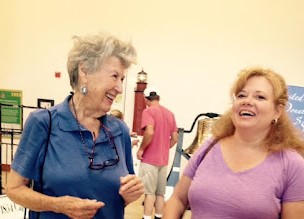
| Meeting up with Dixie. A highlight when visiting Hatteras Island. |
Long ago, back when I still thought saving the cat was the fire department’s problem, I was blessed to make the acquaintance of a seasoned pro who gave me some of the best advice that has not only shaped my writing life, but my real life as well.
I messaged Dixie
Browning for an autographed book for my sister’s birthday. Being the wonderful,
gracious lady that she is, she signed one and sent it back with a very nice
birthday note. I sent her a thank-you and in it, I mentioned that when I was a
kid, I always wanted to be a writer who lived at the beach, so she, Ms. Dixie,
was living my dream life. She wrote back— if
you want to live at the beach, I know a good realtor! And if I wanted to be
a writer, I should just do it!
Such a bold suggestion! Especially
for a small-town girl from West Virginia, a place where big dreams are
smothered in the wet blanket of statistical realities. Rule of thumb, count on West Virginia to rank first in bad things and last in the good ones. Cultural negativity seeps
into the psyche after a while and crushes dreams as they hatch. Too often,
“I will” is followed closely by “I can’t”.
I wrote back that I didn't have a clue even how to start, but I appreciated her hopeful
words.
She responded with half pep
talk, half chide. Dixie grew up in a poor fishing village on an island. A setting she figured was similar to an Appalachian farm town. Fortunately, she'd been too naïve to realize she was supposed to doubt herself. It was too bad I knew enough about stuff to
know what I couldn't do without even trying.
Point taken.
I wrote a sample chapter
and sent it to her. She smothered it in red pen, sent it back, and told me I
was on my way! I simply needed to follow chapter one with chapter two, then three…and
so on and so forth until I “what-iffed” my way to THE END.
It was simple. Sort of.
Once I had my book polished
and ready to submit, she offered me another key piece of advice. As she approached
the end of her writing career, she looked forward to never, ever writing again.
I was shocked. How could
a writer hate to write? She told me it was simple, really. She earned her
living working for the publishing industry and anything you do just to make
money is a job and jobs eventual feel like work.
That offhanded piece of advice has shaped how I approach my “writing career”. I put that in quotes because writing is not my job. It’s what I do for the love of it. Life is too short not to enjoy the heck out of it.
That’s me living my
best life, sans beach cottage.
Dixie Browning published over 100 category romance novels during her writing career. She was a Romance Writers of America RITA Award winner and was a five-time RITA finalist. After her much-too-soon for her reader’s liking retirement from writing, she concentrated on painting watercolor landscapes—her true passion best-life hobby.
Amazon.com:
Dixie Browning: Books, Biography, Blog, Audiobooks, Kindle
Elizabeth Seckman is a writer and admin for the IWSG.


.jpg)


.jpg)
.jpg)

.jpg)