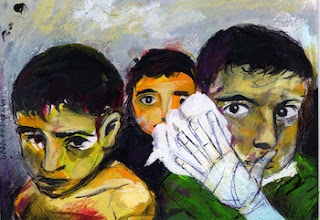
There has been a lot of debate about whether a character needs a wound, and what role the wound plays in characterization. Is a wound necessary? Do characters need some kind of deep trauma in order to give context to their present action behavior and plot? (Check out a very interesting article on the topic here: https://www.newyorker.com/magazine/2022/01/03/the-case-against-the-trauma-plot, free if you haven’t reached your monthly limit of New Yorker articles.)
Image credit Mataparda on Wunderstock (license)
As a writing teacher, I do believe that imagining a backstory for your character can add the type of depth that a lot of stories require. After all, your character doesn’t just exist in the present context of their story. Their actions, reactions, worldview, struggles, etc. have come from somewhere. And while it’s true that the word “trauma” is bandied about, some would argue, too much, it’s an important tool to be aware of in your writing arsenal. (Another interesting consideration here: https://www.nytimes.com/2022/02/04/opinion/caleb-love-bombing-gaslighting-trauma.html, free if you haven’t reached your monthly limit of New York Times articles.) Especially after these last two years, it seems that everything is getting the pop psychology “trauma” treatment.
Often, we teach that a character has a wound or trauma in their backstory, and that this creates their current need. For example, if they have been abandoned by a dismissive parent in their family of origin, they might be unconsciously searching for acceptance from their current situations, relationships, etc. The “need” differs from the “want” or “character objective” because it is generally not something they are willing or able to acknowledge until they realize it. The want or objective is something they are pursuing, ideally, from the beginning. The two can be very different, converging or switching places (in terms of prominence) only when the character realizes the forces that have been driving them all along.
Whether or not your character has a wound or a particular trauma in their backstory is, of course, up to you. There’s also something potentially interesting about having your character’s backstory be positive, rather than negative, in order to combat the trope of the tragic past. If you do choose to use the wound, here are some considerations:
- Reveal the Wound Early: A major (to my thinking) mistake that a lot of writers make is the withholding of the wound. Then it’s revealed at the climax, or shortly before or after, during the “all is lost” (depending on whether you’re using these structures). Suddenly, everything snaps into focus and the character makes sense. I disagree completely with this approach. If we don’t know at least something about the wound and resulting need right away, we’re missing a big piece of the character’s deep identity. We may not see or understand what drives them, why they do what they do, etc. The withholding of crucial character information can work in some mystery/thriller/suspense plots, but otherwise, consider airing all or part of the wound early—so that readers can contextualize your character and understand them right away.
- It Doesn’t Have to Be Huge: What’s significant to your character doesn’t have to be melodramatic or even a big deal to some others. All that matters is that it matters to them, and that readers know why. A missed connection, a cutting remark, the fracture of an early relationship, guilt over something that did or didn’t happen—these can be fertile ground for creating an unrequited need in a character.
- Do Your Research: As referenced above, many people have a working knowledge of how trauma works on the human body, heart, soul, and mind. But tropes and clichés about here, as you can see from my abandonment/acceptance example. Sometimes, significant experiences can manifest in interesting ways. Read up on the wound you plan to use, and don’t be afraid to supplement your creative thinking with more academic explorations, like The Body Keeps the Score by Bessel van der Kolk.
- Deploy Self-Awareness: Something that trips many writers up is the idea that the need/wound are largely unconscious. They can make the character do things against their own self-interest, and otherwise lead to some murky emotions. But I, for one, am also always telling writers to make their characters (more or less) self-aware. How do we square this seemingly contradictory advice? I’d say that the character needs to be aware of their wound (see above, about revealing it), though maybe not all of the ramifications of having it. As the story progresses, they should be open to doing more inquiry about themselves, and exhibit a growing self-awareness of the difference between their want (which drives the first act or more) and their need (which kicks in during act two and really comes full force into act three). A largely suppressed or unconscious character in denial can be tough to relate to for readers. Besides, being aware of something and then acting on that awareness are two very different things—it can take a while for the latter to kick in!
- Consider Your Ending: As you wrap up a character’s story (at least for the current manuscript), consider how to resolve the need. Maybe it’s resolved completely—they get the acceptance they desire! Or maybe there’s more nuance to it—they get a temporary reprieve from the feelings originated by the wound, or they get an unexpected solution that’s different from what they originally wanted (or thought they did). Remember that characters aren’t straightforward, and neither are their endings. It’s rare (and rarely believable) that the perfect solution for one’s wound comes along—and that the effects of psychic satisfaction lasts forever. Maybe all your character gets is temporary support, understanding, visibility, peace, etc. Maybe that’s what they need, though, to be complete … for now.
A character’s backstory doesn’t have to be long, melodramatic, or complex. But I think it’s important to consider what shaped them in the past on their way to their present. Otherwise, you might end up with a character who exists without much anchoring—readers may not have a sense that they are fully fleshed out, simultaneously existing in the present, remembering their past, and thinking about their future. Add these considerations of the wound to your character portraits, and see what develops.
For more advanced story and business insights about writing and publishing, please check out Good Story Learning membership: https://www.goodstorycompany.com/membership Join Mary Kole and the Good Story Company (https://goodstorycompany.com) team for nuanced exploration of all the writing and publishing topics that matter to today’s writer. You can also find Mary’s personal editorial services directly at Mary Kole Editorial (https://marykole.com).

Former literary agent Mary Kole founded Mary Kole Editorial in 2013 and provides consulting and developmental editing services to writers of all categories and genres, working on children’s book projects from picture book to young adult, and all kinds of trade market literature, including fantasy, sci-fi, romance, and memoir. She founded Good Story Company in 2019 with the aim of providing valuable content—like the Good Story Podcast, Story Mastermind, and Good Story Learning—to writers of all categories and ability levels. In 2020, she partnered with literary agent John Cusick to create Upswell Media, an intellectual property company which develops compelling modern middle grade and young adult properties for today’s diverse and dynamic publishing marketplace. She also provides select ghostwriting and done-for-you revision services at Manuscript Studio.
She holds an MFA in Creative Writing and has worked at Chronicle Books, the Andrea Brown Literary Agency, and Movable Type Management. She has been blogging at Kidlit.com since 2009. Her book, Writing Irresistible Kidlit, a writing reference guide for middle grade and young adult writers, is available from Writer's Digest Books/Penguin Random House.